The amount of food you should feed your rabbit each day depends on their age, weight, and breed size. As a general rule, adult rabbits need unlimited timothy hay (roughly a body-sized pile daily), 1/4 to 1/2 cup of pellets per 6 pounds of body weight, 1 to 2 cups of fresh vegetables per 6 pounds of body weight, and only 1 to 2 tablespoons of fruit as an occasional treat. Getting these daily portions right is one of the most important things you can do for your rabbit's long-term health.
Understanding how much hay your rabbit needs each day and pairing it with the correct amounts of pellets, vegetables, and treats prevents obesity, dental disease, and gastrointestinal problems. Below is a complete breakdown of every food group, with exact portions sorted by age and breed size.
Why Getting Your Rabbit's Daily Food Portions Right Matters
A rabbit's digestive system is built for high-fiber, low-sugar foods. Their gut relies on a constant flow of fiber to keep things moving. When the balance tips toward too many pellets, too much fruit, or not enough hay, the consequences can be serious and sometimes fatal.
Overfeeding calorie-dense foods like pellets and treats is one of the leading causes of obesity in pet rabbits. Obese rabbits face higher risks of hepatic lipidosis (fatty liver disease), arthritis, pododermatitis (sore hocks), and a shortened lifespan. On the other end, underfeeding hay or restricting food too much can trigger GI stasis, a condition where the gut slows down or stops entirely. If you want to understand just how critical consistent feeding is, read about how long a rabbit can survive without food and why even short gaps in eating are dangerous.
The four categories of rabbit food, listed in order of importance, are:
- Hay (80% or more of the diet)
- Fresh vegetables (10-15% of the diet)
- Pellets (5% of the diet)
- Treats/fruits (less than 2% of the diet)
Each of these food groups has specific daily portion guidelines based on your rabbit's age and weight. Let's break them down one by one.
How Much Hay Should You Feed Your Rabbit Daily?
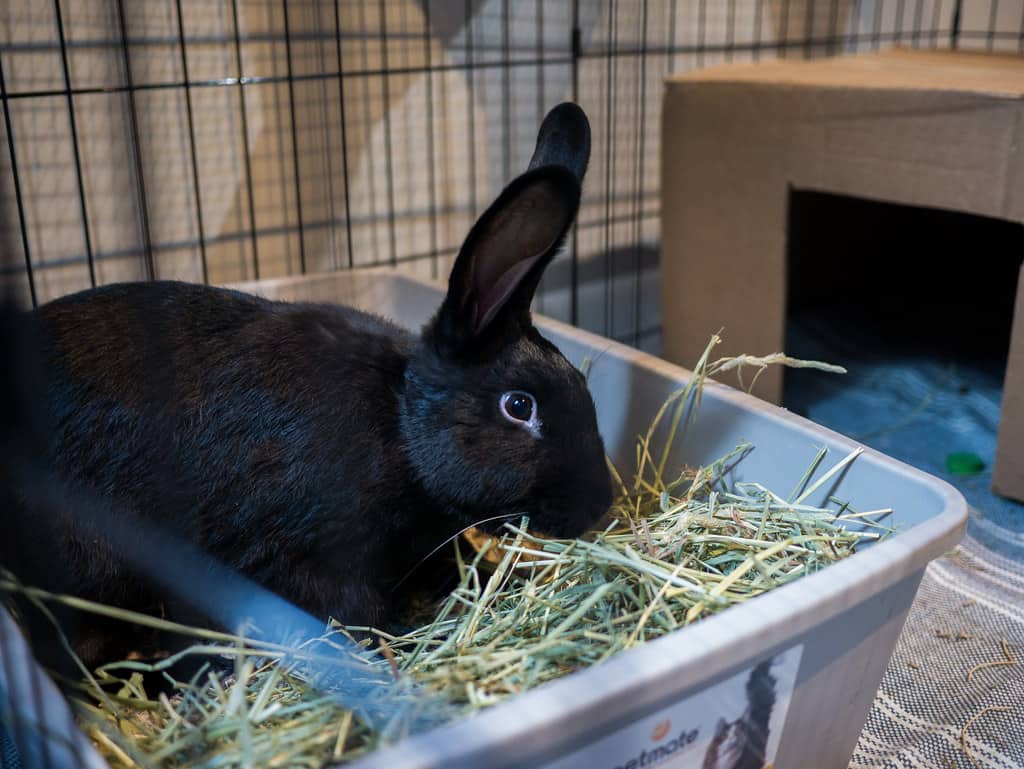
Your rabbit should have unlimited access to hay at all times. Hay should make up at least 80% of your rabbit's total diet, and there is no upper limit. A good visual benchmark is a pile of hay roughly the same size as your rabbit's body, refreshed daily.
Hay is the single most important food for rabbits. The long fibers in hay keep the gut moving, wear down constantly growing teeth, and provide essential nutrients without excess calories. Without adequate hay, rabbits are at serious risk of developing GI stasis, a potentially fatal condition where the digestive system slows or stops completely.
Which Type of Hay by Age
The type of hay matters just as much as the quantity. Here is a breakdown by age:
| Age | Recommended Hay Type | Why |
|---|---|---|
| 7 weeks to 7 months | Alfalfa hay (unlimited) | Higher calcium and protein supports rapid growth |
| 7 months to 1 year | Gradual transition to grass hay | Slowly reduce alfalfa to prevent excess calcium |
| 1 year and older | Timothy, orchard, oat, or meadow hay | Lower calcium prevents bladder sludge and kidney stones |
Excess calcium from feeding alfalfa hay to adult rabbits can lead to bladder sludge, kidney stones, and urinary tract infections. That is why the transition from alfalfa to grass hay during the 7-month to 1-year window is so important. If your rabbit is refusing to eat grass hay at first, try mixing it with a small amount of alfalfa and gradually reducing the alfalfa over 2 to 3 weeks.
If you want a more detailed guide on hay portions and types, see our full article on how much hay a rabbit should eat.
How Much Pellets Should You Feed Your Rabbit Daily?
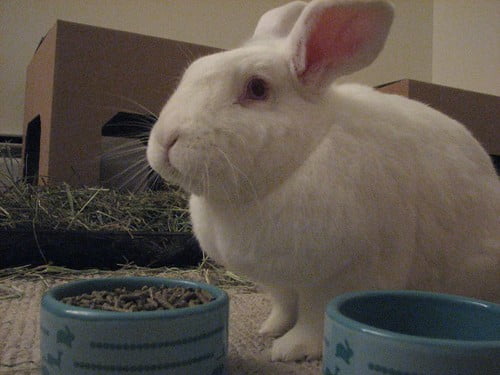
Pellets are a supplement, not the main course. Many new rabbit owners make the mistake of filling a bowl with pellets and letting their rabbit eat freely. This leads to obesity and reduced hay intake, both of which cause serious health problems over time.
For rabbits 7 weeks to 7 months old, pellets (alfalfa-based) can be offered in unlimited amounts alongside unlimited alfalfa hay. Once your rabbit reaches 7 months, you need to start restricting pellets to specific daily amounts.
Daily Pellet Portions for Adult Rabbits (7+ Months)
| Breed Size | Body Weight Range | Daily Pellet Amount |
|---|---|---|
| Small breeds (Netherland Dwarf, Holland Lop, Mini Rex) | 1.1 to 3.5 pounds | 2 to 3 ounces (1/8 cup) |
| Medium breeds (Dutch, Mini Lop, Rex) | 6 to 10 pounds | 3.5 to 4 ounces (1/4 cup) |
| Large breeds (Flemish Giant, New Zealand, Californian) | 9 to 14+ pounds | 4 to 8 ounces (1/4 to 1/2 cup) |
Source: Understanding the Basics of Rabbit Care, Utah State University Extension
A common simplified guideline recommended by many veterinarians is 1/4 cup of pellets per 6 pounds of body weight per day. For a deeper dive into pellet feeding, including what to look for on the label, check our guide on how much pellets a rabbit should eat.
What to Look for in Rabbit Pellets
Not all pellets are created equal. Avoid pellets that contain seeds, dried fruit pieces, colored bits, or corn. These "muesli-style" mixes encourage selective feeding and are linked to higher rates of obesity and dental disease. Instead, choose plain, timothy-based pellets that meet these nutritional benchmarks:
| Nutrient | Recommended Range |
|---|---|
| Fiber | 18% or higher (minimum 12%) |
| Protein | 14% to 18% |
| Fat | 3% or less |
| Calcium | Less than 1% |
Source: American Rabbit Breeders Association, via Utah State University Extension
If your rabbit has stopped eating pellets but is still eating hay, that is usually not a cause for alarm, though it is worth investigating. See our article on why your rabbit is not eating pellets but still eating hay for common causes.
How Many Vegetables Should Your Rabbit Eat Each Day?
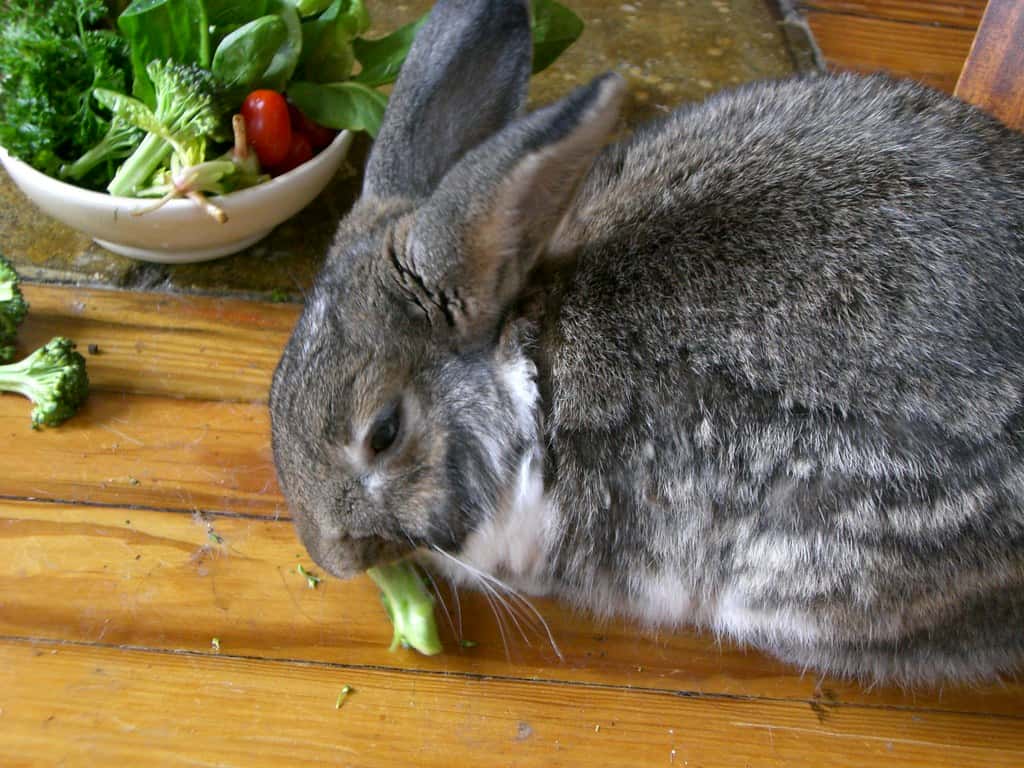
Fresh vegetables are the second most important part of your rabbit's diet after hay. They provide hydration, vitamins, minerals, and variety that pellets alone cannot deliver. The general recommendation for adult rabbits is 1 to 2 packed cups of leafy greens per 6 pounds of body weight per day.
When to Start Introducing Vegetables
Baby rabbits should not eat vegetables until they are at least 12 weeks old. At that point, introduce one new vegetable at a time, starting with just 15 grams per day. Wait 48 to 72 hours before adding another vegetable. This slow approach makes it easy to identify which foods cause soft stool or digestive upset.
By 7 months to 1 year, you can gradually increase vegetable portions to the full adult amount based on your rabbit's weight.
Daily Vegetable Portions by Breed Size
| Breed Size | Body Weight | Daily Vegetable Amount |
|---|---|---|
| Small breeds | 1.1 to 3.5 pounds | Up to 128 grams (about 1 cup) |
| Medium breeds | 6 to 10 pounds | 384 to 640 grams (2 to 3 cups) |
| Large breeds | 9 to 12+ pounds | 384 to 760 grams (2 to 4 cups) |
Source: Patry, Karen, et al. The Rabbit-Raising Problem Solver. Storey Publishing, 2014.
Aim for variety. Rotate between at least 3 different vegetables each day to give your rabbit a broad spectrum of nutrients. Focus on leafy greens, which should make up the majority of the vegetable portion.
Safe Vegetables for Daily Feeding
Stick to vegetables that are proven safe for rabbits. Some of the best options include:
- Cilantro
- Parsley
- Basil
- Romaine lettuce
- Bok choy
- Celery
- Watercress
- Mint
- Bell peppers
- Broccoli (leaves and stems, small amounts)
Some vegetables are higher in oxalates, like spinach and kale. These are safe in rotation but should not be fed daily. Rotate high-oxalate greens with low-oxalate options to prevent calcium buildup.
For the complete list of rabbit-safe vegetables, see our guide on what vegetables you can feed your rabbit.
Vegetables to Never Feed Your Rabbit
Some vegetables are toxic to rabbits and should be avoided completely:
- Rhubarb (leaves and stalks)
- Avocado
- Onions, garlic, leeks, and chives (all allium vegetables)
- Iceberg lettuce (contains lactucarium, which is harmful in large amounts)
- Potatoes (high in starch, difficult to digest)
How Many Treats Can You Give Your Rabbit Daily?
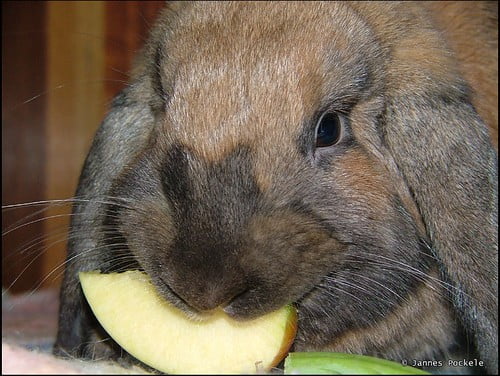
Treats for rabbits should be limited to small portions of fresh fruit. The natural sugars in fruit can disrupt your rabbit's gut bacteria and contribute to obesity when given in excess. A good rule of thumb is no more than 1 to 2 tablespoons of fruit per 5 pounds of body weight, and only 2 to 3 times per week, not daily.
Daily Fruit Limits by Breed Size
| Breed Size | Body Weight | Maximum Fruit Per Serving |
|---|---|---|
| Small breeds | 1.1 to 3.5 pounds | 1 teaspoon to 1 tablespoon |
| Medium breeds | 6 to 10 pounds | 1 to 2 tablespoons (30 to 60 grams) |
| Large breeds | 9 to 12+ pounds | 2 to 4 tablespoons (60 to 120 grams) |
Source: Basic Rabbit Care, Lafeber Veterinary
Safe Fruits for Rabbit Treats
Choose fruits that are lower in sugar when possible. Safe options include:
- Apple (remove seeds and stem)
- Blueberries
- Strawberries
- Raspberries
- Pear (remove seeds)
- Watermelon (flesh only, no rind)
- Papaya
- Banana (very high in sugar, give sparingly)
Avoid all processed human treats: no bread, crackers, cookies, chocolate, or yogurt drops. These contain ingredients that rabbits cannot digest safely and can lead to serious gastrointestinal distress.
Complete Daily Feeding Schedule by Age
One of the most common questions from new rabbit owners is how feeding changes as a rabbit grows. Here is a complete age-by-age breakdown so you know exactly what and how much to offer at every stage. For guidance on meal timing and frequency, see our guide on how many times a day to feed your rabbit.
| Age | Hay | Pellets | Vegetables | Treats |
|---|---|---|---|---|
| Birth to 3 weeks | None (mother's milk only) | None | None | None |
| 3 to 7 weeks | Start nibbling mother's alfalfa hay | Start nibbling mother's pellets | None | None |
| 7 weeks to 12 weeks | Unlimited alfalfa hay | Unlimited alfalfa pellets | None | None |
| 12 weeks to 7 months | Unlimited alfalfa hay | Unlimited alfalfa pellets | Introduce slowly: 15g/day, one veggie at a time | None |
| 7 months to 1 year | Transition to timothy/grass hay | Reduce to 1/4 to 1/2 cup per 6 lbs | Increase to 1 to 2 cups per 6 lbs | Small amounts, 2-3x/week |
| 1 to 5 years (adult) | Unlimited timothy/grass hay | 1/4 to 1/2 cup per 6 lbs | 1 to 2 cups per 6 lbs daily | 1-2 tbsp fruit, 2-3x/week |
| 6+ years (senior) | Unlimited timothy hay (add alfalfa if losing weight) | Increase slightly if underweight | Continue normal amounts | Reduce if weight is a concern |
Senior rabbits over 6 years old may need diet adjustments. If your older rabbit is losing weight, your veterinarian may recommend reintroducing some alfalfa hay or slightly increasing pellet portions to maintain body condition.
How Much Water Does Your Rabbit Need Daily?
Water is just as important as food. A healthy rabbit drinks approximately 50 to 150 milliliters of water per kilogram of body weight each day. That means a 5-pound rabbit (2.3 kg) may drink 115 to 345 ml of water daily, though the exact amount varies with temperature, activity level, and how many fresh vegetables they eat (since veggies contain water).
Always provide fresh, clean water in a heavy ceramic bowl or a bottle. Bowls are generally preferred because rabbits can drink more naturally from them, but bottles work well for rabbits that tend to tip their bowls. Change the water at least once daily, and more often in warm weather.
Signs You Are Overfeeding or Underfeeding Your Rabbit
Even with the best guidelines, it helps to watch your rabbit's body and behavior for signs that their portions need adjusting.
Signs of Overfeeding
- Visible fat deposits around the dewlap, belly, and hindquarters
- Difficulty grooming (especially reaching the hindquarters)
- Soft, mushy droppings or cecotropes left uneaten on the floor
- Reduced hay consumption (filling up on pellets or treats instead)
- Lethargy and reluctance to exercise
Signs of Underfeeding
- Prominent spine and hip bones when you run your hand along the back
- Increased chewing on cage bars, baseboards, or other non-food items
- Eating cecotropes excessively (or eating droppings that are not cecotropes)
- Dull, rough coat
- Low energy and reduced activity
If you notice any of these signs, adjust portions gradually over 1 to 2 weeks rather than making sudden changes. A rabbit's gut bacteria need time to adapt to dietary shifts.
Common Feeding Mistakes to Avoid
After years of breeding and caring for rabbits, here are the most frequent mistakes we see new owners make with daily feeding:
- Making pellets the main food. Pellets should be a small supplement. Hay is always the foundation.
- Offering unlimited pellets to adult rabbits. This was the recommendation decades ago, but modern veterinary guidance limits pellets to prevent obesity.
- Introducing too many new vegetables at once. Always introduce one new vegetable at a time and wait 2 to 3 days before adding another.
- Giving fruit daily. Fruit is a treat, not a daily food. Limit it to 2 to 3 times per week in small amounts.
- Using muesli-style pellet mixes. These colorful mixes with seeds, corn, and dried fruit encourage selective feeding and are nutritionally unbalanced.
- Forgetting hay variety. While timothy is the standard, mixing in orchard grass, oat hay, or meadow hay keeps your rabbit interested and eating consistently.
- Not providing enough water. Dehydration reduces appetite and can trigger GI stasis. Always make sure clean water is available.
Frequently Asked Questions
Can I feed my rabbit only hay and no pellets?
Yes, adult rabbits can survive on hay and vegetables alone without pellets. Pellets are convenient for ensuring your rabbit gets consistent vitamins and minerals, but they are not strictly necessary if your rabbit eats a varied diet of high-quality hay and a wide rotation of fresh vegetables daily.
How do I know if my rabbit is eating enough hay?
Check your rabbit's droppings. Healthy rabbits produce 200 to 300 round, firm, golden-brown fecal pellets per day. If the droppings are small, dark, or irregular in shape, your rabbit likely needs more hay. You should also see the hay pile noticeably reduced each day.
Should I feed my rabbit at the same time every day?
Rabbits are creatures of habit and do best with a consistent feeding schedule. Most owners feed fresh vegetables and pellets in the morning and evening, while keeping hay available around the clock. A predictable routine also makes it easier to notice if your rabbit suddenly loses interest in food.
Is it okay to free-feed pellets to baby rabbits?
Yes. Rabbits under 7 months old can have unlimited alfalfa-based pellets because they need the extra calories, protein, and calcium for growth. Once your rabbit reaches 7 months, begin gradually reducing pellets to the adult portion size over 2 to 3 weeks.
What should I do if my rabbit refuses to eat vegetables?
Some rabbits, especially those raised primarily on pellets, may be hesitant about vegetables at first. Start with mild-flavored greens like romaine lettuce or cilantro. Place a small piece near their hay so they encounter it naturally. Most rabbits will start sampling vegetables within a few days once they become familiar with the smell and texture.
Cite this article:
BunnySync (February 28, 2026) How Much Food Should I Feed My Rabbit a Day? Complete Daily Feeding Guide. Retrieved from https://bunnysync.com/blog/how-much-food-should-i-feed-my-rabbit-a-day.
"How Much Food Should I Feed My Rabbit a Day? Complete Daily Feeding Guide." BunnySync - February 28, 2026, https://bunnysync.com/blog/how-much-food-should-i-feed-my-rabbit-a-day
Related Articles
Sources
- Patry, Karen, et al. The Rabbit-Raising Problem Solver: Your Questions Answered about Housing, Feeding, Behavior, Health Care, Breeding, and Kindling. Storey Publishing, 2014.
- Understanding the Basics of Rabbit Care, Utah State University Extension
- Basic Rabbit Care, Lafeber Veterinary
- Blas, Carlos de., and Julian Wiseman. The Nutrition of the Rabbit. CAB International, 1998.
- Gastrointestinal Stasis in Rabbits, VCA Hospitals