Rabbit nails should be short enough that they do not touch or splay on a flat surface when your rabbit is standing normally. As a general guideline, nails should sit just above the fur line of the paw and never curl or twist to the side. For most house rabbits, this means trimming every 4 to 6 weeks, though rabbits that spend time on rough outdoor surfaces may go longer between trims. Knowing how long your rabbit's nails should be, and how to keep them at the right length, is one of the most important grooming skills every owner needs.
In this guide, we cover the ideal nail length for rabbits of different ages and breeds, how to tell when nails are overdue for a trim, step-by-step trimming techniques, and what to do if something goes wrong. Whether you are a first-time rabbit owner or a seasoned breeder, keeping nails at the proper length prevents pain, posture problems, and serious injuries.
What Is the Ideal Nail Length for a Rabbit?
There is no single millimeter measurement that works for every rabbit, because nail length depends on the breed size, foot fur thickness, and overall body proportions. Instead, use these visual and physical tests to judge the correct length:
- Flat surface test: Place your rabbit on a hard, flat surface like a tile floor. When standing naturally, the nails should not touch the floor or cause the toes to splay outward. If you can hear clicking when your rabbit hops, the nails are too long.
- Fur line test: Look at the paw from the side. The tip of each nail should sit at or just slightly past the fur line. If nails extend well beyond the fur, they need a trim.
- Curl test: Nails that have started to curve downward or sideways are overdue. Curling nails change the angle of the toe, which puts stress on joints and tendons.
For small breeds like Netherland Dwarfs and Holland Lops, nails tend to grow quickly relative to their body size, and the quick (the blood vessel inside the nail) is shorter. For large breeds like Flemish Giants and New Zealand Whites, nails are thicker and the quick extends further, so you need to trim more carefully to avoid cutting into it.
How Do You Tell If a Rabbit's Nails Are Too Long?

Overgrown nails cause real problems for rabbits. Here are the signs that your rabbit's nails have gone too long:
Visible Curling or Twisting
The most obvious sign is nails that curl under the paw or twist to the side. Once nails reach this stage, they can catch on cage wire, carpet fibers, or blankets. A caught nail can rip out entirely, causing severe bleeding and pain. If your rabbit's nails have reached the curling stage, trim them immediately or visit a vet if you are not comfortable doing it yourself.
Changes in Gait or Movement
Rabbits with overgrown nails often shift their weight to the back of their feet to avoid pressure on the nail tips. You might notice your rabbit hopping less, sitting in one spot more than usual, or moving with a slow, careful gait. Over time, this unnatural posture leads to sore hocks, which are painful ulcers on the bottom of the feet. Sore hocks can become infected and are difficult to treat once established.
Reluctance to Be Handled
If your rabbit suddenly resists being picked up or flinches when you touch their paws, overgrown nails could be the cause. Long nails press into the toe pad when the foot is flexed, which is painful. A rabbit that was previously calm during handling but now struggles or nips may be showing signs of stress related to nail discomfort.
Scratching You or Other Pets
Long, sharp nails turn a friendly pawing gesture into an accidental scratch. If you are getting scratched during handling or playtime, that is a clear signal the nails need attention. This is especially important in households with children or other small pets.
How Often Should You Trim Your Rabbit's Nails?
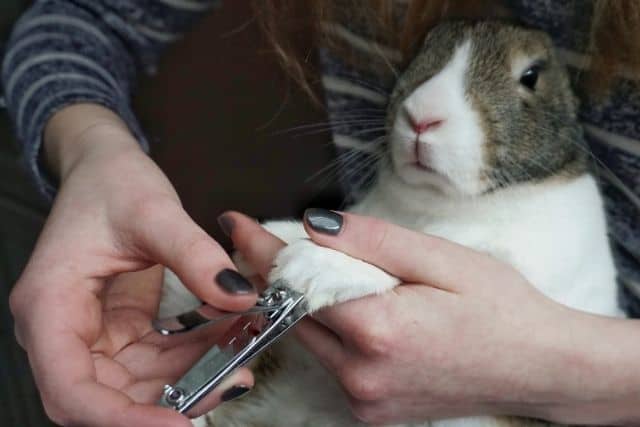
The trimming schedule depends on your rabbit's living environment and activity level. Here is a general guide:
| Living Environment | Recommended Trim Frequency | Why |
|---|---|---|
| Indoor only (carpet/tile) | Every 4 to 6 weeks | Smooth surfaces provide no natural filing |
| Indoor with rough mats or stone tiles | Every 6 to 8 weeks | Some natural wear from textured surfaces |
| Outdoor access with digging opportunities | Every 8 to 10 weeks | Digging and rough ground file nails naturally |
| Full-time outdoor hutch with yard access | Check monthly, trim as needed | May rarely need trimming if active digger |
Wild rabbits almost never have overgrown nails because they dig burrows, run on packed earth, and scrape against rocks daily. House rabbits do not get this natural wear, so the responsibility falls on you. If you want to extend the time between trims, consider providing a digging box filled with soil or placing a rough ceramic tile in your rabbit's enclosure. For more strategies, check out our guide on how to naturally wear down your rabbit's claws.
Regardless of the schedule, check your rabbit's nails every two weeks by doing a quick visual inspection. This takes 30 seconds and helps you catch overgrowth before it becomes a problem.
At What Age Can You Start Trimming a Rabbit's Nails?
You can begin trimming nails as early as 8 to 12 weeks of age. At this stage, kits have thin, needle-sharp nails that grow quickly. Here is what to keep in mind when trimming young rabbits:
- Start early to build habits: Rabbits that get used to nail trimming as babies are far calmer about it as adults. Even if the nails are not long enough to need a real trim, handle the paws regularly so your kit gets accustomed to the process.
- Use small, sharp clippers: Human nail clippers work well for kits. The small cutting surface gives you more control on tiny nails.
- Trim less, more often: Take the tiniest tip off each nail every 2 to 3 weeks rather than waiting for significant growth. This keeps the quick short and receding, which makes future trims easier and safer.
- Be extremely careful with the quick: Young rabbit nails are translucent, making the quick (the pink vein inside) easy to see. Never cut into it. If you accidentally nick the quick on a young rabbit, the pain can create lasting fear of nail trims. If a nail does bleed, apply styptic powder or cornstarch immediately and read our guide on what to do if your rabbit's nail is bleeding.
If you are raising a litter, start handling paws from the first week of life so the kits grow up comfortable with human touch. This makes every grooming task easier down the line, not just nail trims.
Why Is It Important to Keep Your Rabbit's Nails Trimmed?
Nail trimming is not cosmetic grooming. It is a health necessity. Here are the specific risks of letting nails grow too long:
Joint and Posture Damage
When nails grow past the proper length, they force the toes to angle unnaturally. This changes how your rabbit distributes weight across the foot. Over weeks and months, this altered posture strains the joints in the toes, ankles, and hocks. Senior rabbits and heavy breeds are especially vulnerable to arthritis caused or worsened by overgrown nails.
Sore Hocks (Pododermatitis)
As mentioned earlier, overgrown nails cause rabbits to shift weight to the backs of their feet. This constant pressure on the heel area breaks down the skin and fur, leading to sore hocks. Early-stage sore hocks appear as thinning fur on the heel. Advanced cases involve open sores, scabbing, and bacterial infection that require veterinary treatment.
Torn or Ripped Nails
Long nails catch on everything: cage wire, fabric, carpet loops, hay racks. When a nail catches and the rabbit pulls away in panic, the nail can rip partially or completely out of the nail bed. This is extremely painful and bleeds heavily. In severe cases, the exposed nail bed can become infected, requiring antibiotics.
Difficulty Eating and Grooming
Rabbits use their front paws to hold food, wash their face, and groom their ears. Overgrown nails make these everyday activities awkward and uncomfortable. You might notice your rabbit dropping food more often or developing a dirty face and ears because grooming has become difficult.
Behavioral Changes
Pain and discomfort from overgrown nails can make a rabbit irritable, aggressive, or withdrawn. If your rabbit has become nippy, avoids interaction, or seems lethargic, checking the nails is one of the first things you should do. Just like overgrown teeth can threaten a rabbit's life, neglected nails can seriously impact quality of life.
How to Trim Your Rabbit's Nails: Step-by-Step Guide
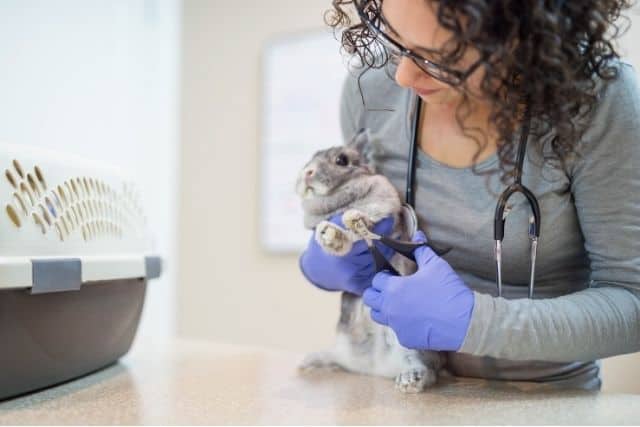
Trimming rabbit nails is straightforward once you know the technique. Here is the process we use in our rabbitry:
What You Need
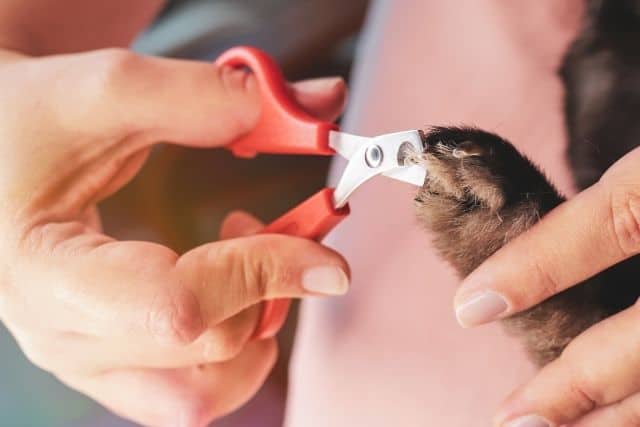
- Small animal nail clippers (guillotine style or scissor style) or sharp human nail clippers
- Styptic powder or cornstarch (in case you nick the quick)
- A towel or blanket for wrapping
- A flashlight (for dark-nailed rabbits)
- A helper (optional but useful, especially for nervous rabbits)
Step 1: Position Your Rabbit
The safest position is the "bunny burrito." Wrap your rabbit snugly in a towel with only one paw exposed at a time. This prevents kicking and keeps the rabbit calm. Some rabbits do well cradled on their back in your lap, but many find this position stressful. If your rabbit goes limp on its back, it is likely in a state called tonic immobility, which is a fear response, not relaxation. The burrito wrap is a better choice.
If your rabbit panics during handling, read our guide on how to calm down a scared rabbit before attempting a nail trim.
Step 2: Identify the Quick
The quick is the pink blood vessel and nerve that runs through the center of the nail. On light-colored nails, you can see it clearly as a pink line. On dark nails, shine a flashlight behind the nail to illuminate the quick. The goal is to cut 2 to 3 millimeters past the end of the quick, leaving a small buffer of clear nail.
If you cannot see the quick at all, trim only the very tip of the nail (1 to 2 millimeters). It is better to trim too little and come back in a week than to cut too much and hit the quick.
Step 3: Make the Cut
Hold the paw firmly but gently. Isolate one toe at a time by pressing lightly on the pad to extend the nail. Position the clippers perpendicular to the nail (not at an angle) and make one clean, quick cut. Do not squeeze slowly, as this crushes the nail rather than cutting it cleanly.
Work through all five nails on the front paw (yes, rabbits have five toes on each front foot) and four nails on each back paw. Do not forget the dewclaw on the inside of the front paws. This nail does not touch the ground and grows quickly because it gets zero natural wear.
Step 4: Handle Bleeding If It Happens
If you cut the quick, stay calm. Your rabbit will flinch and the nail will bleed, but this is not a medical emergency. Press styptic powder or cornstarch firmly against the nail tip for 30 to 60 seconds. The bleeding should stop within a minute or two. If bleeding continues for more than 5 minutes, contact your vet.
After nicking the quick, give your rabbit a break. Finish the remaining nails another day if needed. Pushing through will only make your rabbit associate nail trims with prolonged stress.
What About the Quick? How to Keep It Short
The quick grows longer when nails are left untrimmed for extended periods. This creates a frustrating cycle: the nails are long, but you cannot trim them short because the quick has extended too far. Here is how to handle it:
- Trim a small amount every 1 to 2 weeks. Each time you trim close to (but not into) the quick, it naturally recedes. After 4 to 6 sessions, the quick will have shortened enough to achieve the proper nail length.
- Use a flashlight every time. Even on light nails, a flashlight gives you a clearer view of exactly where the quick ends.
- Keep a consistent schedule. The quick stays short when nails are trimmed regularly. Skipping trims for months allows the quick to grow, undoing your progress.
For rabbits with severely overgrown nails where the quick extends nearly to the tip, a veterinarian can trim the nails back in stages while managing any minor bleeding with professional-grade cautery.
Tools for Trimming Rabbit Nails
Not all clippers are created equal. Here is a comparison of the most common options:
| Clipper Type | Best For | Pros | Cons |
|---|---|---|---|
| Scissor-style small animal clippers | Most rabbits | Good visibility, precise control | Can dull quickly with thick nails |
| Guillotine-style clippers | Thick nails on large breeds | Clean cut, less crushing | Harder to position correctly |
| Human nail clippers | Kits and small breeds | Easy to find, precise on tiny nails | Not strong enough for adult large breeds |
| Electric nail grinder (Dremel) | Nervous rabbits who hate clipping | No risk of cutting the quick | Noise can scare some rabbits, slow process |
Replace or sharpen your clippers regularly. Dull blades crush the nail instead of cutting it, which is painful and can cause splitting.
Special Considerations by Breed and Age
Senior Rabbits
Older rabbits are less active and do less natural filing of their nails. At the same time, their nails often become thicker and more brittle. Trim senior rabbits more frequently (every 3 to 4 weeks) and use sharp clippers to avoid nail splitting. Senior rabbits are also more prone to arthritis, so overgrown nails that alter posture are especially dangerous for them.
Rex and Mini Rex Breeds
Rex breeds have thinner foot fur padding, which makes them more susceptible to sore hocks. Keeping nails at the proper length is critical for these breeds because any posture change hits their feet harder than breeds with thick foot fur.
Large Breeds (Flemish Giant, Continental Giant)
Giant breeds have proportionally larger quicks and thicker nails. Always use heavy-duty clippers and trim conservatively. Their body weight means overgrown nails cause faster onset of hock and joint problems.
Angora and Long-Haired Breeds
The thick foot fur on Angora rabbits can hide nail length. Part the fur carefully during inspections. You may need to trim the fur around the feet to get a clear view of the nails and to prevent matting between the toes.
Can You File Rabbit Nails Instead of Clipping?
Yes, you can use a nail file or emery board to smooth nail tips after clipping or as a standalone maintenance method between trims. Filing does not replace clipping for significantly overgrown nails, but it is a good way to keep edges smooth and extend the time between full trims. Some rabbits tolerate filing better than clipping because there is no sudden pressure or sound.
An electric nail grinder (like a pet Dremel on low speed) is another option. It gradually sands down the nail, making it nearly impossible to hit the quick. The trade-off is that the vibration and noise can stress some rabbits. Introduce the grinder gradually: let your rabbit sniff it while it is off, then while running, before ever touching it to a nail.
When to See a Vet for Nail Trimming
Most rabbit owners can trim nails at home with practice. However, see a veterinarian if:
- Your rabbit's nails are severely overgrown with long quicks that prevent safe trimming at home
- A nail has been torn or ripped out and the bleeding will not stop
- You notice swelling, redness, or discharge around any nail bed (signs of infection)
- Your rabbit has sore hocks that may be connected to nail overgrowth
- You are a first-time owner and want a professional demonstration before doing it yourself
Many rabbit-savvy vets will trim nails during a regular checkup at no extra charge. Some will let you watch and walk you through the process so you can do it confidently at home next time.
Frequently Asked Questions
How short should I cut my rabbit's nails?
Cut 2 to 3 millimeters past the end of the quick, which is the pink vein visible inside the nail. The nail tip should sit at or just past the fur line of the paw. If you cannot see the quick, trim only the very tip and come back in a week to take more off gradually.
What happens if you never trim a rabbit's nails?
Untrimmed nails curl under the paw, change how your rabbit stands and walks, and lead to sore hocks, joint pain, and torn nails. In severe cases, curled nails grow into the paw pad, causing infection and requiring veterinary intervention. Regular trimming every 4 to 6 weeks prevents all of these issues.
Do rabbit nails need to be trimmed if they live outside?
Outdoor rabbits with access to dirt, rocks, and digging opportunities wear down their nails naturally and may need less frequent trims. However, you should still check their nails monthly. Not all outdoor surfaces provide enough abrasion, and individual rabbits vary in how much they dig.
Can I use human nail clippers on my rabbit?
Yes, standard human nail clippers work well for baby rabbits and small breeds. For adult medium and large breed rabbits, use dedicated small animal clippers that are designed to handle thicker nails without crushing them.
My rabbit won't let me trim its nails. What should I do?
Try the burrito wrap technique with a towel to secure your rabbit with only one paw exposed. Work in short sessions, trimming just a few nails at a time with treats between each one. If your rabbit remains extremely stressed, have a vet or experienced groomer do the trimming while you learn their technique.
Cite this article:
Cite this article:
BunnySync (March 12, 2026) How Long Should Rabbit Nails Be?. Retrieved from https://bunnysync.com/blog/how-long-should-rabbit-nails-be.
"How Long Should Rabbit Nails Be?." BunnySync - March 12, 2026, https://bunnysync.com/blog/how-long-should-rabbit-nails-be
Sources and further reading
- Buseth, Marit Emilie., and Richard A. Saunders. Rabbit Behaviour, Health, and Care. CABI, 2014.
- Lebas, F. The Rabbit: Husbandry, Health, and Production. Food and Agriculture Organization of the United Nations, 1997.
- Patry, Karen, et al. The Rabbit-Raising Problem Solver: Your Questions Answered about Housing, Feeding, Behavior, Health Care, Breeding, and Kindling. Storey Publishing, 2014.
- How To Trim Rabbit Nails - The Spruce Pets
- Do I need to trim my rabbit's nails? - RSPCA Australia