Rabbits can technically wear collars, but most experienced rabbit keepers and vets strongly advise against them. The anatomy of a rabbit makes collars genuinely dangerous: their necks are fragile, their skeletons are lightweight, and they can panic and thrash suddenly in ways that cause serious injury. If you are asking whether can rabbits wear collars safely, the honest answer is no, not in any practical everyday sense. There are far safer alternatives for identification, outdoor walks, and post-surgery care that do not put your rabbit at risk.
Should You Put a Collar on Your Rabbit?

The short answer is no. Even if your rabbit sits calmly while you put a collar on, the risks that come with leaving it on unsupervised are not worth it. Rabbits are prey animals with a strong instinct to flee. A sudden movement or fright response can result in a neck injury within seconds.
Many new rabbit owners reach for collars because that is what they know from dogs and cats. But rabbits are built differently. Their bones are surprisingly delicate relative to the power of their hind legs. A rabbit kicking out against restraint can fracture its own spine, and a collar adds another point of failure.
Even if the collar fits well today, rabbits can lose or gain weight quickly depending on season, diet, or illness. A collar that fit perfectly last month can become dangerously tight within a few weeks without you noticing.
If your goal is identification, there are better options. If your goal is outdoor exercise, a well-fitted harness is the appropriate tool. If you are dealing with post-surgery care, an E-collar designed for rabbits is the right approach. Collars solve none of these problems well.
What Are the Risks of Putting a Collar on a Rabbit?

The risks are not theoretical. Vets and rabbit rescue organisations see collar-related injuries regularly. Understanding exactly what can go wrong helps you make an informed decision for your rabbit.
Strangulation and Entanglement
Rabbits are curious, active animals that love to explore tight spaces and push through gaps in furniture, fencing, and enrichment items. A collar can catch on cage wire, a toy hook, or a plant stand. Once a rabbit is caught and begins to panic, the situation escalates within seconds. Entanglement injuries are often fatal.
Spinal and Neck Injury
A rabbit's skeleton makes up only around 8 percent of its total body weight, far less than most other companion animals. The muscles of the hind legs, however, are extremely powerful for that body size. If a rabbit lunges or kicks while a collar is attached to something, the force goes directly into the neck. Spinal fractures and dislocations are well-documented in collar-related incidents.
Learning the signs that your rabbit is stressed is important any time you introduce new accessories or restraint. Thumping, freezing, bolting, and grinding teeth are all signs that your rabbit is not comfortable and a risky situation may be developing.
Skin Problems Beneath the Collar
Collars trap moisture, fur, and debris against the skin. In rabbits, this can quickly lead to sore hocks-style irritation around the neck, fur loss, and in worse cases, fly strike or infection. Because rabbits groom themselves thoroughly and flex their necks constantly, even a small area of irritation can escalate fast.
Psychological Stress
Wearing a collar is not a natural sensation for a rabbit. Unlike dogs, who are generally conditioned from puppyhood to accept collars, rabbits have no instinctive tolerance for having something around their neck. The constant awareness of the collar can keep a rabbit in a low-grade state of stress, affecting appetite, social behaviour, and overall health.
- Entanglement: Collar catches on wire, furniture, or cage fixtures
- Strangulation: Rabbit panics and tightens the collar against its own neck
- Spinal fracture: Powerful hind leg kick while restrained by collar
- Skin irritation: Trapped fur and moisture cause sores
- Chronic stress: Ongoing discomfort affects appetite and behaviour
What About Breakaway Collars for Rabbits?
Breakaway collars are designed to release under pressure, which sounds like a safer option. In cats, they work reasonably well. In rabbits, the situation is more complicated.
The problem is that a breakaway collar must be tight enough to stay on during normal movement, but loose enough to release under sudden pressure. With rabbits, normal movement already involves significant neck flexion and rapid directional changes. A collar loose enough to break away easily is also loose enough to catch on things at lower speeds, which defeats the purpose.
Some breakaway collars marketed for rabbits do exist, but they are not widely endorsed by rabbit welfare organisations or exotic vets. The House Rabbit Society does not recommend collars as a standard part of rabbit care for exactly this reason.
If you are looking for something your rabbit can wear that breaks away safely in an emergency, a well-fitted breakaway harness is a better starting point than a collar. Even then, unsupervised wear is not recommended.
Is a Harness Safer Than a Collar for Rabbits?

Yes, a harness is significantly safer than a collar if your goal is to take your rabbit outdoors or give them supervised exercise in an unfenced area. A harness distributes pressure across the chest and shoulders rather than concentrating it on the neck, which dramatically reduces the risk of neck injury.
That said, a harness is not without its own risks. Rabbits can still panic outdoors, and an improperly fitted harness can slip off or become a restraint hazard. Harness use should always be supervised, and you should never leave a rabbit unattended in a harness.
If you are concerned about whether your rabbit is getting enough movement, read about the exercise needs of rabbits and whether lack of exercise can be dangerous. For most rabbits, a safe, enclosed garden or a large indoor space is preferable to leash walks.
Types of Rabbit-Safe Harnesses
Not all harnesses are suitable for rabbits. Cat and small dog harnesses are often the wrong shape for a rabbit's body and can cause pressure points or restrict breathing. Look specifically for harnesses designed with rabbit anatomy in mind.
| Harness Type | How It Works | Best For |
|---|---|---|
| Figure-H harness | Two loops connected by a central strap across the back | Most rabbit breeds, easy to fit |
| Vest harness | Fabric panel wraps around the chest and shoulders | Rabbits that resist step-in harnesses |
| Figure-8 harness | Two loops around neck and chest, connected at back | Smaller breeds, short supervised outings |
Avoid harnesses with a loop that sits across the back of the neck. Any pressure on the neck area brings you back to the same risks as a collar.
How to Harness Train Your Rabbit
Harness training takes patience and should never be rushed. A rabbit that is forced into a harness and taken outside before it is comfortable will associate the harness with fear, making future training much harder.
- Leave the harness near your rabbit's living area for several days so they can sniff and investigate it at their own pace.
- Offer a treat each time your rabbit approaches or touches the harness voluntarily.
- Practice placing the harness on your rabbit indoors for short periods before attempting to attach a leash.
- Attach the leash and let it trail loosely while your rabbit moves around indoors.
- Only move to outdoor sessions once your rabbit is fully relaxed indoors with the harness and leash on.
Understanding how to handle and hold rabbits safely is also essential during harness training. Many rabbits dislike being picked up, and attempting to harness a rabbit who is already stressed from handling will make the process harder for both of you.
Tips for Walking a Rabbit on a Harness
Walking a rabbit is nothing like walking a dog. Rabbits do not follow a path on command. They explore on their own schedule, stop frequently to sniff and graze, and may suddenly bolt if they see, hear, or smell something alarming.
- Choose a quiet, enclosed area away from traffic, dogs, and loud noises
- Keep sessions short, especially at the beginning (10 to 15 minutes maximum)
- Let the rabbit lead rather than pulling on the leash
- Never leave the rabbit unattended, even for a moment
- Bring the rabbit inside immediately if it shows signs of stress such as thumping, freezing, or trying to bolt
- Check for toxic plants in the area before allowing your rabbit to graze
Should You Microchip Your Rabbit Instead?
If identification is the reason you were considering a collar, microchipping is the far better solution. A microchip is a small RFID chip, roughly the size of a grain of rice, inserted under the skin between the shoulder blades. It carries a unique number linked to your contact details on a national database.
Microchipping does not stress the rabbit on an ongoing basis the way a collar would. It is a one-time procedure done by a vet, and most rabbits recover from it quickly with no lasting discomfort. There is no risk of entanglement, strangulation, or skin irritation.
In many countries, microchipping is now the standard expectation for rabbits kept as pets, particularly for breeders who sell or rehome animals. If your rabbit ever escapes or is stolen, a microchip gives you a real chance of being reunited with them. A collar can fall off or be removed. A microchip cannot.
The RSPCA recommends microchipping as part of responsible rabbit ownership and notes it as a far safer identification method than any external tag or collar.
Can Rabbits Wear Elizabethan (E-Collars)?
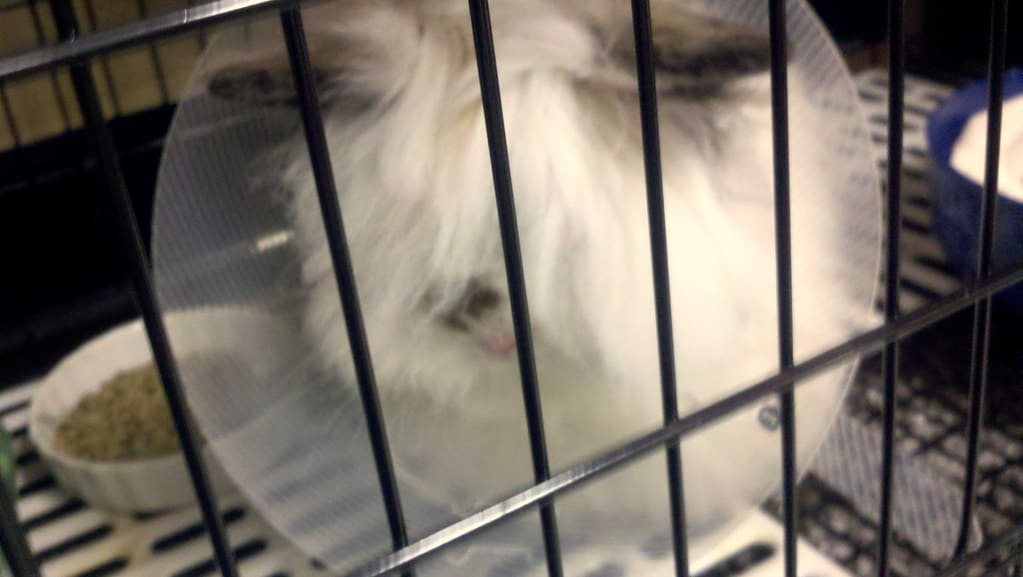
Elizabethan collars, also called E-collars or cone collars, are a different situation from everyday collars. They are sometimes prescribed by vets after surgery or injury to prevent a rabbit from licking or biting a wound. In this context, they can be a necessary tool rather than an optional accessory.
However, E-collars for rabbits come with significant challenges. Unlike dogs and cats, rabbits are hindgut fermenters that need to eat cecotropes directly from their anus. An E-collar can prevent this, which quickly leads to nutritional deficiency and GI problems. Rabbits also groom themselves as a primary way of regulating body temperature and stress, and an E-collar disrupts this entirely.
If your rabbit has had surgery and you are trying to prevent wound interference, read about how to stop a rabbit from licking stitches for strategies that do not always require a full E-collar. In some cases, a softer inflatable donut collar or careful bandaging is sufficient and less disruptive than a traditional cone.
If your vet has prescribed an E-collar, follow their guidance closely. Ask specifically about how long your rabbit will need to wear it, how to monitor for GI stasis signs, and whether cecotrope intake can be supplemented in some way during recovery. Also make sure you are informed about pre-surgery care and fasting guidelines if your rabbit is due for a procedure.
When an E-Collar Might Be Necessary
- After spay or neuter surgery when the rabbit is aggressively licking the incision site
- After treatment of wounds or abscesses
- During recovery from dental surgery where mouth access is a concern
- When topical medications need to stay in place and the rabbit is removing them
In all cases, an E-collar on a rabbit should be a short-term, vet-directed measure with active monitoring, not a long-term solution.
How to Identify Your Rabbit Without a Collar
Identification is one of the most common reasons people consider collars for rabbits. Fortunately, there are several effective alternatives that do not carry the same risks.
| Method | How It Works | Pros | Cons |
|---|---|---|---|
| Microchip | RFID chip inserted under skin by a vet | Permanent, tamper-proof, widely recognised | Requires vet visit, scanner to read |
| Ear tattoo | Ink tattoo applied to inner ear, common in breeding | Visible without equipment, permanent | Requires training or vet, fades over time |
| Ear tag | Small clip-on or through-ear tag used in livestock settings | Cheap, visible at a distance | Not suitable for pet rabbits, can cause injury |
| Photographs | Detailed photo record of markings, colour, body shape | No physical intervention needed | Relies on matching at recovery, markings can be similar |
For pet rabbits, microchipping combined with a detailed photo record is the gold standard. For breeding rabbits, a combination of ear tattoo and breeder records provides the traceability needed for registration purposes without the need for any ongoing accessory.
Frequently Asked Questions
Can rabbits wear a collar for identification purposes?
Collars are not recommended for rabbit identification because of the significant injury risks. Microchipping is the safest and most reliable identification method for rabbits. It is permanent, cannot be removed or fall off, and is recognised by vets and rescue organisations. Most rabbit vets can microchip your rabbit during a routine appointment.
What size collar would fit a rabbit safely?
There is no collar size that fits a rabbit safely for unsupervised wear. Even a correctly sized collar can become a strangulation or entanglement hazard. Rabbits' necks are disproportionately fragile relative to the power of their back legs, and a sudden bolt or kick while wearing a collar can cause severe neck injury regardless of fit.
Are cat collars safe for rabbits?
No. Cat collars, including breakaway versions, are not safe for rabbits. They are shaped for a cat's anatomy, not a rabbit's, and they still concentrate any force on the neck. Even a breakaway cat collar may not release fast enough to prevent injury when a rabbit panics and lunges with the full force of its hind legs.
Can I put a harness on my rabbit to take it outside?
Yes, a well-fitted rabbit harness is a much safer option than a collar for supervised outdoor time. Choose a harness specifically designed for rabbits, introduce it gradually indoors, and never leave your rabbit unattended while wearing it. Keep outdoor sessions short and in a calm, enclosed environment away from dogs and traffic.
Do rabbits need a collar after surgery?
Not always. Some rabbits require an E-collar after surgery to prevent wound interference, but this is a short-term medical measure prescribed by a vet, not an everyday accessory. Alternatives like inflatable donut collars or careful bandaging may be sufficient in some cases. Always follow your vet's specific advice for post-surgical care.
Cite this article:
Cite this article:
BunnySync (March 11, 2026) Can Rabbits Wear Collars? Safety Risks and Better Alternatives. Retrieved from https://bunnysync.com/blog/can-rabbits-wear-collars.
"Can Rabbits Wear Collars? Safety Risks and Better Alternatives." BunnySync - March 11, 2026, https://bunnysync.com/blog/can-rabbits-wear-collars