You should feed your rabbit twice a day, once in the morning and once in the evening. This schedule mimics the natural feeding pattern of wild rabbits, which are crepuscular animals that eat primarily at dawn and dusk. As breeders, we have found that splitting meals into two daily feedings keeps rabbits healthier, prevents overeating, and gives you two daily opportunities to check on your rabbit's appetite and overall condition. Knowing how much total food your rabbit needs each day is just as important as knowing how often to feed.
That said, some rabbits need adjusted feeding frequency depending on their age, reproductive status, and activity level. Growing kits, pregnant does, and lactating mothers all require more food than a typical adult rabbit. Below, we break down exactly how to structure your rabbit's feeding routine for optimal health.
How Often Should You Feed a Rabbit?
The standard recommendation is two scheduled meals per day, supplemented with unlimited hay available at all times. This twice-daily routine works for the vast majority of domestic rabbits regardless of breed.
The reason twice daily works so well comes down to biology. Research on basic rabbit care from Lafeber Veterinary confirms that domestic rabbits retain the same feeding instincts as their wild counterparts. Wild rabbits are most active at dawn and dusk, and that is when they forage for food. Domestic rabbits show the same pattern, becoming more alert and eager to eat during early morning and evening hours.
However, certain rabbits need more frequent or larger feedings:
- Growing kits (under 7 months): Should have unlimited pellets and alfalfa hay throughout the day
- Pregnant does: Need roughly three times the normal food amount
- Lactating does: Also require about three times the standard ration
- Underweight or recovering rabbits: May benefit from three smaller meals spread across the day
What Is the Best Feeding Schedule for Rabbits?
Creating a consistent feeding schedule is one of the most important things you can do for your rabbit's digestive health. Rabbits thrive on routine. Their gut relies on a steady flow of fiber to function properly, and irregular feeding times can cause stress and digestive slowdowns.
Morning Feeding Routine
The morning meal is your rabbit's first real nutrition after a night of hay grazing. It should include:
- A measured portion of pellets (based on your rabbit's size, see the table below)
- A fresh handful of leafy greens or safe vegetables for rabbits
- A check and top-up of their hay supply
- Fresh, clean water
We use the morning feeding as an opportunity to quickly assess each rabbit's condition. Are they eager for food? Did they finish last night's portion? Are their droppings normal in size and quantity? These quick daily checks can catch health issues early before they become serious.
Evening Feeding Routine
The evening meal is typically the larger of the two. Many breeders, ourselves included, give the bulk of the pellet ration in the evening because rabbits are naturally more active and hungry as the sun goes down. Your evening feeding should include:
- The remaining pellet portion for the day
- A generous serving of fresh hay (rabbits eat most of their hay overnight)
- An additional serving of fresh vegetables if desired
Sample Daily Feeding Timetable
| Time | Food Type | Amount |
|---|---|---|
| 7:00 AM | Pellets | 1/3 of daily pellet ration |
| 7:00 AM | Fresh vegetables | 1 cup of mixed greens per 6 lbs body weight |
| All day | Hay | Unlimited (body-sized portion minimum) |
| All day | Water | Fresh and unlimited |
| 7:00 PM | Pellets | 2/3 of daily pellet ration |
| 7:00 PM | Fresh vegetables | 1 cup of mixed greens per 6 lbs body weight |
| 7:00 PM | Hay | Top up for overnight grazing |
How Much Should You Feed Your Rabbit by Breed Size?
The amount of food your rabbit needs depends heavily on their breed size. A Netherland Dwarf weighing 2 pounds has very different caloric needs than a Flemish Giant weighing 14 pounds. Understanding how many pellets your rabbit should eat is essential to preventing both overfeeding and underfeeding.
| Breed Size | Weight Range | Daily Pellets | Daily Vegetables | Hay |
|---|---|---|---|---|
| Small breeds (Netherland Dwarf, Mini Rex, Holland Lop) | 2 to 5 lbs | 2 to 3 ounces | 1 cup mixed greens | Unlimited |
| Medium breeds (Dutch, Rex, English Angora) | 5 to 10 lbs | 3.5 to 4 ounces | 1.5 to 2 cups mixed greens | Unlimited |
| Large breeds (New Zealand, Californian, Flemish Giant) | 10 to 20+ lbs | 4 to 8 ounces | 2 to 4 cups mixed greens | Unlimited |
These pellet amounts should be split between two meals. For example, a medium breed rabbit getting 4 ounces per day would receive roughly 1.3 ounces in the morning and 2.7 ounces in the evening. All breeds should have unlimited access to hay regardless of size.
How Much Should You Feed a Rabbit at Each Life Stage?
A rabbit's dietary needs change significantly as they grow from kit to senior. Getting the transitions right is critical for proper development and long-term health.
| Age | Hay | Pellets | Vegetables | Fruit |
|---|---|---|---|---|
| 7 weeks to 7 months | Unlimited alfalfa | Unlimited | None | None |
| 12 weeks onward | Unlimited alfalfa | Unlimited | Introduce one at a time, less than 1/2 oz (15g) | None |
| 7 months to 1 year | Transition from alfalfa to grass hay | Decrease to 1/2 cup per 6 lbs body weight | Gradually increase daily amount | No more than 1 to 2 oz per 6 lbs body weight |
| Adult (1 to 5 years) | Unlimited timothy, orchard, or oat hay | 1/4 to 1/2 cup per 6 lbs body weight | 1 to 2 cups per 6 lbs body weight | No more than 2 tablespoons per 6 lbs body weight |
| Senior (6+ years) | Increase alfalfa hay for frail seniors, monitor calcium | Continue adult portions unless underweight | Same as adult | Same as adult |
The transition from alfalfa to grass hay between 7 months and 1 year is particularly important. Alfalfa is high in calcium and protein, which growing kits need. But adult rabbits can develop kidney or bladder stones from excess calcium. Make the switch gradually over 2 to 3 weeks by mixing increasing amounts of grass hay with decreasing amounts of alfalfa.
Source: Basic Rabbit Care, Lafeber Veterinary
What Should a Balanced Rabbit Diet Include?
A healthy rabbit diet consists of four main components in very specific proportions. Getting this balance right matters more than almost any other aspect of rabbit care.
Hay: 80 to 85% of the Diet
Hay is the single most important food for any rabbit. Timothy hay, orchard grass, and meadow hay are all excellent choices for adult rabbits. To learn more about the specific amounts, read our guide on how much hay a rabbit needs daily.
Hay provides the long-strand fiber that keeps a rabbit's gut moving and wears down their continuously growing teeth. A rabbit should eat a body-sized portion of hay every single day at minimum. Without constant access to hay, rabbits can develop GI stasis, a potentially fatal condition where the digestive system slows or stops entirely.
Pellets: 5 to 10% of the Diet
Pellets are a concentrated source of vitamins and minerals, but they should not be the primary part of your rabbit's diet. Look for plain, timothy-based pellets with the following nutritional profile:
| Nutrient | Recommended Range |
|---|---|
| Fiber | 18% minimum (12% to 22% range) |
| Protein | 14% to 18% |
| Fat | 3% or less |
| Calcium | Less than 1% |
Avoid muesli-style mixes with colorful pieces, seeds, or dried fruit. Rabbits will pick out the sugary, unhealthy bits and leave the nutritious parts behind. If you are unsure about whether rabbits truly need pellets, the short answer is that pellets are helpful but not strictly essential as long as the rabbit gets enough hay and fresh vegetables.
Source: Understanding the Basics of Rabbit Care, Utah State University
Fresh Vegetables and Leafy Greens
Fresh vegetables provide essential vitamins, hydration, and dietary variety. Aim for 1 to 2 cups of mixed greens per 6 pounds of body weight daily. Here are some of the best options:
| Leafy Greens (feed daily) | Other Vegetables (rotate regularly) |
|---|---|
| Romaine lettuce | Bell peppers |
| Cilantro | Zucchini |
| Parsley | Broccoli leaves |
| Basil | Carrot tops |
| Mint | Celery |
| Dandelion greens | Bok choy |
| Watercress | Brussels sprouts |
Introduce new vegetables one at a time and wait 24 hours before adding another. This way, if a vegetable causes soft stool or digestive upset, you can identify the culprit immediately.
Fruit: Occasional Treats Only
Fruit is high in sugar and should only be given as an occasional treat. Limit fruit to no more than 2 tablespoons per 6 pounds of body weight, offered no more than 2 to 3 times per week. Safe fruit options include apple slices (no seeds), strawberries, blueberries, and banana.
Water
Fresh water should be available at all times, and you should change your rabbit's water regularly. Research published in The Veterinary Nurse found that most rabbits prefer drinking from open bowls rather than sipper bottles. Test both options and see which your rabbit prefers. Clean and refill the water container daily regardless of how much was consumed.
Can You Overfeed a Rabbit?
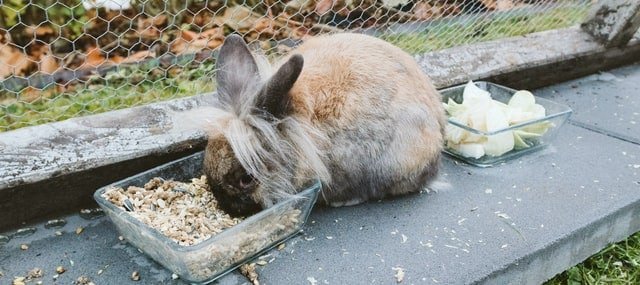
Yes, overfeeding is one of the most common mistakes pet rabbit owners make. Rabbits are natural grazers with a strong instinct to eat whenever food is available. In the wild, this behavior makes sense because food can be scarce. In a domestic setting where food is always present, it leads to obesity.
The risks of overfeeding include:
- Obesity: Strains the heart, liver, and joints
- Reduced cecotrope consumption: Overweight rabbits physically cannot reach their cecotropes, missing out on essential B vitamins
- GI stasis: An overfed rabbit eating too many pellets may eat less hay, slowing gut motility
- Fatty liver disease: Hepatic lipidosis is a serious and sometimes fatal condition in obese rabbits
- Shortened lifespan: Obese rabbits live significantly shorter lives than those at a healthy weight
According to research from Utah State University, rabbits that are free-fed (given unlimited pellets throughout the day) tend to overeat and become overweight. The solution is simple: measure out the daily pellet ration and split it between your two scheduled feedings.
The one exception is hay. You cannot overfeed hay. Rabbits should always have unlimited access to fresh hay, and consuming large quantities of it is actually a sign of good health.
Can You Feed a Rabbit Once a Day?
Technically, yes. If your schedule only allows one feeding, you can give the full day's ration of pellets and vegetables in a single meal. Your rabbit will not suffer serious harm from this approach, especially if they have unlimited hay and fresh water available at all times.
That said, twice-daily feeding is better for several reasons:
- It spreads caloric intake more evenly across the day
- It gives you two daily checkpoints to monitor your rabbit's health and appetite
- It prevents your rabbit from gorging on pellets all at once and then having nothing until the next day
- It more closely mirrors their natural crepuscular eating pattern
If you must feed once a day, do it in the evening when rabbits are naturally more active and hungry. Make sure the hay rack is fully stocked so they have something to graze on throughout the day.
Do Rabbits Stop Eating When They Are Full?
Rabbits are natural grazers, similar to cattle and other livestock. When it comes to hay, they generally eat at a steady pace throughout the day and night, taking breaks as needed. This is perfectly fine and should be encouraged.
The problem arises with calorie-dense foods like pellets, fruits, and starchy vegetables. Rabbits do not have a strong internal signal telling them to stop eating these foods. As prey animals, their instinct is to eat quickly and move to safety, which means they often consume more than they need before recognizing that they are satisfied.
This is exactly why measured portions are so important. Relying on your rabbit to self-regulate with pellets or treats will almost certainly lead to weight gain over time.
To monitor whether you are feeding the right amount:
- Weigh them weekly using a kitchen or pet scale and track the trend
- Feel their ribs and spine regularly. You should be able to feel them easily, but they should not be visibly protruding
- Check their dewlap (the fold under the chin). A very large dewlap on a female, or any dewlap on a male, can indicate excess weight
- Observe droppings: Healthy droppings should be round, dry, and uniform in size. Very small or irregularly shaped droppings can signal dietary issues
Signs Your Rabbit Is Not Getting Enough Food
While overfeeding is the more common problem, underfeeding also happens, particularly with new owners who are overly cautious about portions. Watch for these warning signs:
- Visible ribs, spine, or hip bones when you look at your rabbit from above
- Excessive chewing on bedding, cardboard, or cage bars
- Unusually small or infrequent droppings
- Lethargy or a noticeable drop in activity level
- Consistent weight loss when weighed weekly
- Aggressive or frantic behavior during feeding time
If you notice any of these signs, gradually increase the food amount over several days and consult a rabbit-savvy veterinarian to rule out underlying health problems such as dental disease or parasites.
Frequently Asked Questions
Should I feed my rabbit at the same time every day?
Yes. Rabbits are creatures of habit, and their digestive systems work best on a consistent schedule. Try to feed within the same 30-minute window each morning and evening. Sudden changes to feeding times can cause stress and digestive upset.
Can baby rabbits eat the same food as adults?
No. Kits under 7 months old should have unlimited alfalfa hay and pellets to support their rapid growth. After 7 months, gradually transition them to measured portions of timothy hay-based pellets and unlimited grass hay over a period of 2 to 3 weeks.
What if my rabbit is not eating pellets but still eating hay?
A rabbit that eats hay but refuses pellets is not in immediate danger, since hay is the most critical part of the diet. However, persistent pellet refusal can signal dental problems, a change in pellet brand or formula, or the early stages of illness. If the refusal lasts more than 48 hours, consult a rabbit-savvy veterinarian.
How long can a rabbit go without eating?
A rabbit that stops eating entirely is a medical emergency. After just 12 hours without food, the gut can begin to slow dangerously, increasing the risk of GI stasis. If your rabbit has not eaten anything for more than 12 hours, seek veterinary care immediately.
Is it okay to leave pellets out all day for my rabbit?
No. Free-feeding pellets almost always leads to overeating and obesity. Measure out the daily ration and split it between two scheduled meals. Hay, on the other hand, should be available around the clock.
Cite this article:
Cite this article:
BunnySync (February 23, 2026) How Many Times A Day Should You Feed Your Rabbit?. Retrieved from https://bunnysync.com/blog/how-many-times-a-day-should-i-feed-my-rabbit.
"How Many Times A Day Should You Feed Your Rabbit?." BunnySync - February 23, 2026, https://bunnysync.com/blog/how-many-times-a-day-should-i-feed-my-rabbit