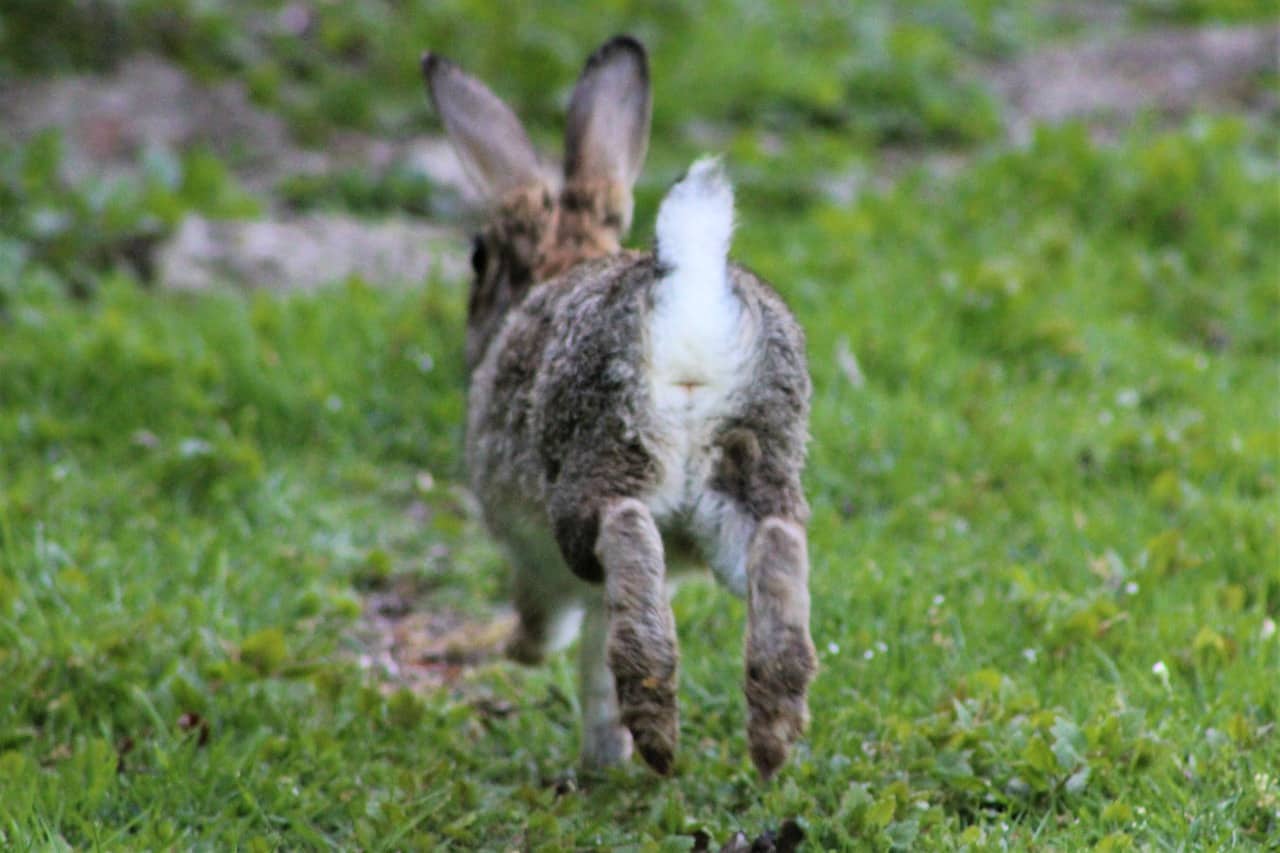
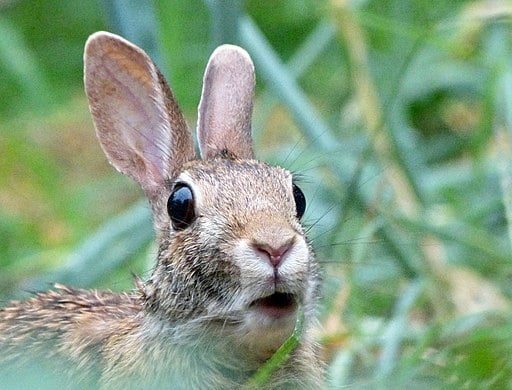
Yes, rabbits can see behind them without turning their heads. Thanks to nearly 360-degree panoramic vision, a rabbit's field of view covers almost every angle around its body, including directly behind it. This remarkable ability is one of the key survival adaptations that has helped rabbits evade predators for millions of years. Their eyes sit high and to the sides of their skull, giving them a visual range of roughly 340 to 360 degrees.
Understanding how rabbit vision works is useful for pet owners and breeders alike. It explains why your rabbit reacts to movement you thought was out of sight, and it helps you approach your rabbit in ways that feel safe rather than threatening. Below, we break down the science of rabbit eyesight, their blind spots, how different breeds compare, and practical tips for living with an animal that can literally see you coming from any direction.

How Does a Rabbit's Vision Work?
Rabbit eyes are positioned laterally, meaning they sit on the sides of the head rather than facing forward like human eyes. This placement is common among prey animals. It sacrifices depth perception in exchange for the widest possible field of view. Each eye independently covers roughly 170 to 190 degrees, and the combined visual field overlaps only slightly in front of the nose and behind the head.
This lateral eye placement is the foundation of what scientists call monocular vision. Each eye processes its own image of the world independently, sending separate signals to the brain. The result is a nearly complete sphere of awareness around the rabbit's body at all times.
Monocular Vision vs. Binocular Vision
Humans rely heavily on binocular vision, where both eyes focus on the same object to create depth perception. Rabbits have only a narrow band of binocular overlap, roughly 10 to 30 degrees directly in front of their face. This small forward-facing zone gives them just enough depth perception to judge distances when foraging or hopping through tight spaces.
The trade-off is clear: rabbits sacrifice detailed forward depth perception for an enormous peripheral view. For a prey animal, detecting a hawk swooping from above or a fox creeping from behind matters far more than judging the exact distance to a blade of grass.
Are Rabbits Farsighted or Nearsighted?
Rabbits are naturally farsighted (hyperopic). Their eyes are optimized to detect movement and shapes at a distance rather than fine detail up close. According to research published by the University of Miami Department of Biology, rabbits have a grainy, somewhat blurry view of objects within a few inches of their face. This is why your rabbit may not notice a treat placed right under its nose but will startle at a bird flying past a window across the room.
Their retinas also contain a higher proportion of rod cells compared to cone cells. Rod cells are excellent for detecting motion and seeing in low light, while cone cells handle color and fine detail. This rod-heavy retina means rabbits excel at spotting movement in their environment, even in dim conditions, making them especially alert at dawn and dusk when they are most active.
How Far Can Rabbits See Behind Them?
A rabbit's rear visual range is essentially the same as its forward range. Because each eye covers such a wide arc, the area directly behind the rabbit's body is well within its field of vision. Under good lighting conditions, rabbits can detect movement at distances of several hundred feet in any direction, including behind them.
The clarity of what they see behind them depends on distance. Objects far away appear sharper to a farsighted rabbit than objects close by. A predator approaching from 50 feet behind a rabbit is more visible to the rabbit than a hand reaching toward it from 6 inches away. This is a critical detail for rabbit owners who wonder why their pet flinches when approached from behind at close range but seems calm when someone walks across the room.
Where Are a Rabbit's Blind Spots?
Despite their impressive visual coverage, rabbits do have blind spots. Understanding these gaps helps owners interact with their rabbits more gently and explains certain behaviors.
The Nose Blind Spot
The most significant blind spot is a narrow cone of about 10 degrees directly in front of and below the nose. Because the eyes are set so far to the sides, they simply cannot converge on the small area right at the tip of the muzzle. This is why rabbits rely heavily on their whiskers and sense of smell when investigating objects at very close range. If you place food directly in front of a rabbit's nose, it may nudge around with its whiskers before finding it.
The Chin Blind Spot
Rabbits also cannot see directly below their chin. This area falls outside the coverage of both eyes. It is another reason rabbits use scent glands located under their chin to mark territory. They cannot see what is directly beneath their jaw, so they rely on touch and scent instead.
A Small Zone Behind the Ears
There is a very small blind area directly behind and between the ears at the top of the head. While the visual field nearly closes behind the rabbit, the ears themselves can block a tiny sliver of rear visibility. In practice, this blind spot is so narrow that most movement behind the rabbit is still detected. However, a very slow, deliberate approach from directly above and behind the ears could theoretically avoid detection, which is exactly how some aerial predators attack.
Do All Rabbit Breeds Have Panoramic Vision?

All domestic and wild rabbit breeds share the same fundamental eye structure and lateral placement that produces panoramic vision. However, certain breed characteristics can reduce the effective visual field.
Large Breeds
Giant breeds like Flemish Giants and Continental Giants have larger body mass that can partially block portions of their peripheral view. Their wide shoulders and bulky frames mean that looking directly behind them may require a slight head turn that smaller, leaner breeds do not need. The difference is minor, but it exists.
Long-Haired Breeds
Breeds such as Angora, Lionhead, and Jersey Wooly rabbits grow fur that can fall over or around their eyes. An Angora with an ungroomed coat may have significantly obstructed vision in all directions, not just behind. Regular grooming and careful trimming around the face are important for these breeds, both for their safety and their comfort. A rabbit that cannot see approaching hands or other animals will be more stressed and more likely to bite or flee unpredictably.
Lop-Eared Breeds
Lop rabbits (Holland Lop, English Lop, French Lop, and others) have ears that hang down beside their face. While the ears themselves do not cover the eyes, their positioning can partially obstruct the lower-rear peripheral vision. Lop owners should be aware that their rabbits may have slightly reduced awareness of what is happening at ground level behind them compared to upright-eared breeds.
How Rabbit Vision Compares to Human Vision
| Feature | Rabbits | Humans |
|---|---|---|
| Field of view | Nearly 360 degrees | About 180 degrees |
| Binocular overlap | 10 to 30 degrees (front only) | About 120 degrees |
| Depth perception | Poor (limited binocular zone) | Excellent |
| Motion detection | Excellent (rod-heavy retina) | Good |
| Color vision | Limited (blue and green) | Full (red, green, blue) |
| Night vision | Good (crepuscular adaptation) | Moderate |
| Close-up detail | Poor (farsighted) | Sharp within a few inches |
This table highlights the fundamental difference: rabbit eyes are built for threat detection, while human eyes are built for detail and focus. Neither system is "better" in an absolute sense. Each evolved to serve the survival needs of its species.
Can Rabbits See Color?
Rabbits have limited color vision compared to humans. Research indicates they can perceive blue and green wavelengths but are largely unable to distinguish red. Their world likely appears in muted tones of blue, green, and gray. This is consistent with their crepuscular lifestyle. At dawn and dusk, color perception is less useful than sensitivity to movement and contrast, which is exactly what their rod-heavy retinas provide.
For rabbit owners, this means that a bright red toy is not more attractive to your rabbit than a gray one. Rabbits respond more to movement, texture, and scent than to color. If you want to engage your rabbit, wave an object gently rather than relying on a vibrant color to catch its attention.
Can Rabbits See in the Dark?
Rabbits are not afraid of the dark and can see reasonably well in low-light conditions. As crepuscular animals (most active at dawn and dusk), their eyes are adapted to the dim transitional light of early morning and late evening. The abundance of rod cells in their retinas allows them to detect shapes and motion in conditions that would leave a human nearly blind.
That said, rabbits cannot see in complete darkness. They still need some ambient light. In a pitch-black room, a rabbit relies on its whiskers, hearing, and sense of smell rather than its eyesight. This is one reason rabbits that sleep with their eyes open in dim rooms still feel secure: they can detect just enough light to monitor for threats.
Practical Tips for Rabbit Owners
Knowing how your rabbit sees the world can improve the way you interact with it daily. Here are some actionable tips based on rabbit vision science.
Approach From the Side, Not Directly From Above
Since the small blind spot behind the ears aligns with where aerial predators strike from, reaching over a rabbit's head from above can trigger a fear response. Instead, approach from the side where your rabbit can clearly see your hand coming. Move slowly and let your rabbit acknowledge your presence before making contact.
Offer Food at Whisker Level
Because of the blind spot at the nose tip, placing food right against your rabbit's mouth may confuse it briefly. Hold treats a few inches in front and slightly to the side so the rabbit can see them clearly before reaching forward.
Keep Enclosures Away From High-Traffic Areas
With nearly 360-degree vision, a rabbit in a busy room detects every movement happening around it. This can cause chronic stress if the rabbit never gets a break from visual stimulation. Place enclosures in a calm area where sudden movements from people, other pets, or even screen reflections are minimized.
Watch for Signs of Vision Problems
If your rabbit starts bumping into objects, flinching at close contact more than usual, or showing reluctance to explore, it could indicate a vision problem. Conditions like cataracts, E. cuniculi (a parasitic infection), and glaucoma can reduce a rabbit's visual field. Early veterinary attention can prevent further deterioration in many cases.
Groom Long-Haired Breeds Regularly
If you keep an Angora, Lionhead, or any breed with long facial fur, trim the hair around the eyes on a regular schedule. A rabbit that cannot see clearly becomes stressed, jumpy, and harder to handle. Keeping the visual field unobstructed is both a welfare issue and a practical one for daily care.
Why Rabbit Vision Matters for Breeders
For those involved in rabbit breeding, understanding vision is more than a curiosity. It has practical implications for housing design, handling protocols, and even genetics.
When designing hutches and colony setups, consider that every rabbit in the space can see nearly everything happening around it at all times. Rabbits housed in view of stressed or fighting neighbors can themselves become stressed, affecting breeding performance, appetite, and overall health.
Handling pregnant does or new mothers requires extra care. A doe with kits is already on high alert. Approaching her from a direction she can clearly monitor (the side rather than from above or behind) reduces the risk of her panicking and injuring her litter.
Breed selection also plays a role. If you breed long-haired rabbits, vision checks should be part of your routine health assessments. A breeding doe or buck with obstructed vision may be more aggressive during handling or less attentive to kits due to the stress of impaired sight.
Frequently Asked Questions
Can rabbits see directly behind their head?
Yes. A rabbit's laterally placed eyes give it nearly 360-degree vision, which includes the area directly behind its body. Only a very small zone between the ears at the top of the head may be slightly obstructed. In practice, rabbits detect movement behind them without needing to turn around.
Why does my rabbit still get startled from behind?
Even though rabbits can see behind them, sudden or fast movement can still trigger a startle reflex. Rabbits are prey animals with strong flight instincts. Quick movements from any direction, including behind, may cause them to bolt or thump as a warning signal regardless of whether they saw it coming.
Do rabbits have better eyesight than cats?
Rabbits have a wider field of view than cats, but cats have superior depth perception, night vision, and close-range focus. Cats are predators built for tracking and pouncing. Rabbits are prey animals built for detecting threats from every direction. Each species has eyes optimized for its ecological role.
Can baby rabbits see behind them right away?
Newborn rabbits (kits) are born with their eyes closed and do not open them until around 10 to 12 days of age. Once their eyes open, their visual field develops rapidly, and they gain full panoramic vision within the first few weeks of life.
Does fur affect a rabbit's ability to see behind them?
Yes. Breeds with long facial and head fur, such as Angoras and Lionheads, can have partially obstructed vision if their coat is not regularly trimmed. Keeping the fur around the eyes short ensures the rabbit maintains its full field of view.
Cite this article:
Cite this article:
BunnySync (March 6, 2026) Can Rabbits See Behind Them?. Retrieved from https://bunnysync.com/blog/can-rabbits-see-behind-them.
"Can Rabbits See Behind Them?." BunnySync - March 6, 2026, https://bunnysync.com/blog/can-rabbits-see-behind-them